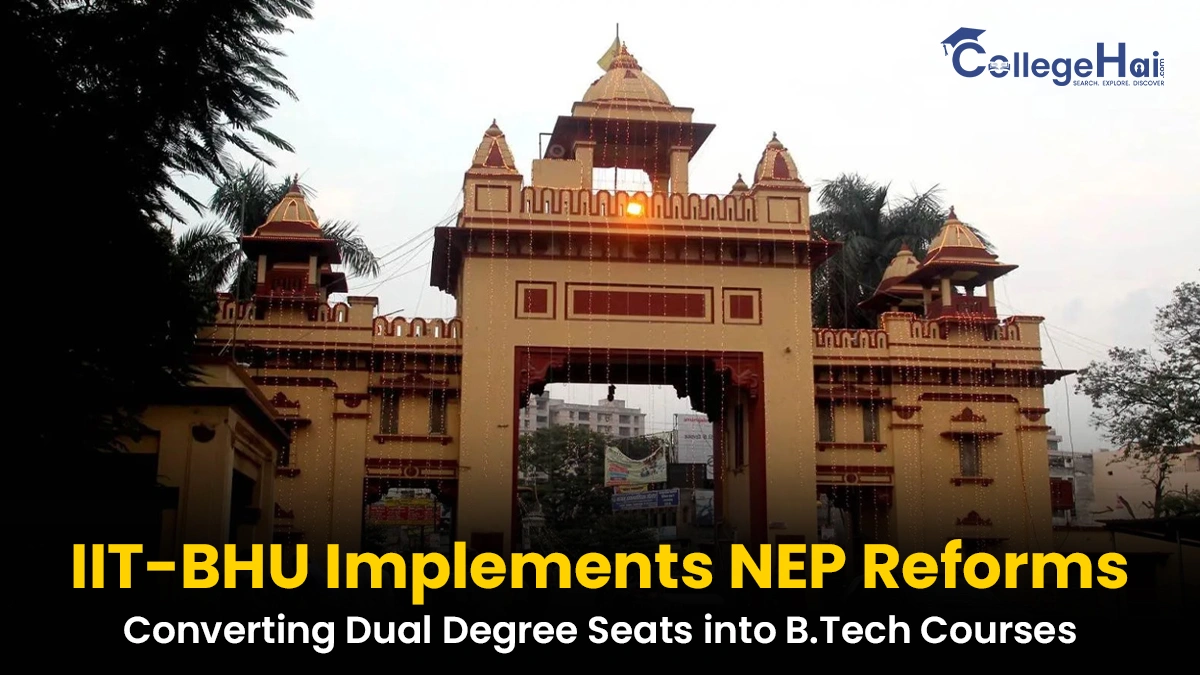
In a significant academic reorganisation, the Indian Institute of Technology (BHU) has declared a fundamental restructuring of its undergraduate engineering courses. The institute is transitioning its old five-year Integrated Dual Degree (IDD) courses into four-year BTech programs, which will provide students with more options and align with the National Education Policy (NEP) guidelines.
IIT BHU has long been providing 17 five-year integrated courses that were a combination of a Bachelor of Technology degree and a Master of Technology degree. With the old system, students who joined these programmes were not allowed to drop out after four years; they had to take both degrees in a single course. However, this model was too strict to fit the contemporary needs of the students, and the institute found it difficult to adapt to the needs of the students because most students wanted to graduate earlier or take other courses after obtaining their BTech.
IIT BHU: What’s Changing?
Since July 2025, all the seats that were previously allocated to the traditional IDD programmes will be included in the B.Tech seats in the respective disciplines. IIT BHU stresses that this change does not decrease the total undergraduate admissions through JEE Advanced; the number of students joining it through the exam has not changed.
The M.Tech component of the dual degree has not been abandoned, however, completely. Rather, it has been made optional; students have the option to take a Master's level course in the same subject at the end of the sixth semester of their B.Tech, which is effectively a five-year course only when they wish to.
More Choices for Students
In order to accommodate a wide range of interests and careers, IIT BHU currently provides a variety of options in its redesigned program:
1. Plain B.Tech: A four-year degree for the student.
2. B.Tech (Honours): Additional depth in the primary subject.
3. Minor: Students may receive a Minor in a different field after the fourth semester.
4. Major in a different subject: After the fourth semester, take a second major, which will make the programme five years.
5. Optional M.Tech IDD: Select a Master's stream in six semesters.
The institute says that this redesign increases academic flexibility and interdisciplinary access to students, one of the key aims of the NEP push towards flexible and student-centred education.
Why the Change?
IIT BHU mentioned the strict nature of the previous integrated programmes as one of the fundamental causes of the redesign. Students were also trapped and could not leave early with a B.Tech in case they changed their targets. The institute also observed the changing interests of students, with most of them desiring the option of flexibility to seek jobs, research or further studies after four years instead of being tied to a five-year category.
The officials clarified that the move was a curriculum reform and not a reaction to the faculty shortages or falling student numbers, and that no programmes were removed. The current students who are already enrolled in the IDD stream will remain in the old system.
This restructuring makes IIT BHU the leader in NEP-led educational reform, a wider pattern in Indian technical education as institutes such as IITs are restructuring programmes to reflect changing student aspirations and industry needs.