Experiential Learning in PGDM: Why Business Simulations Matter

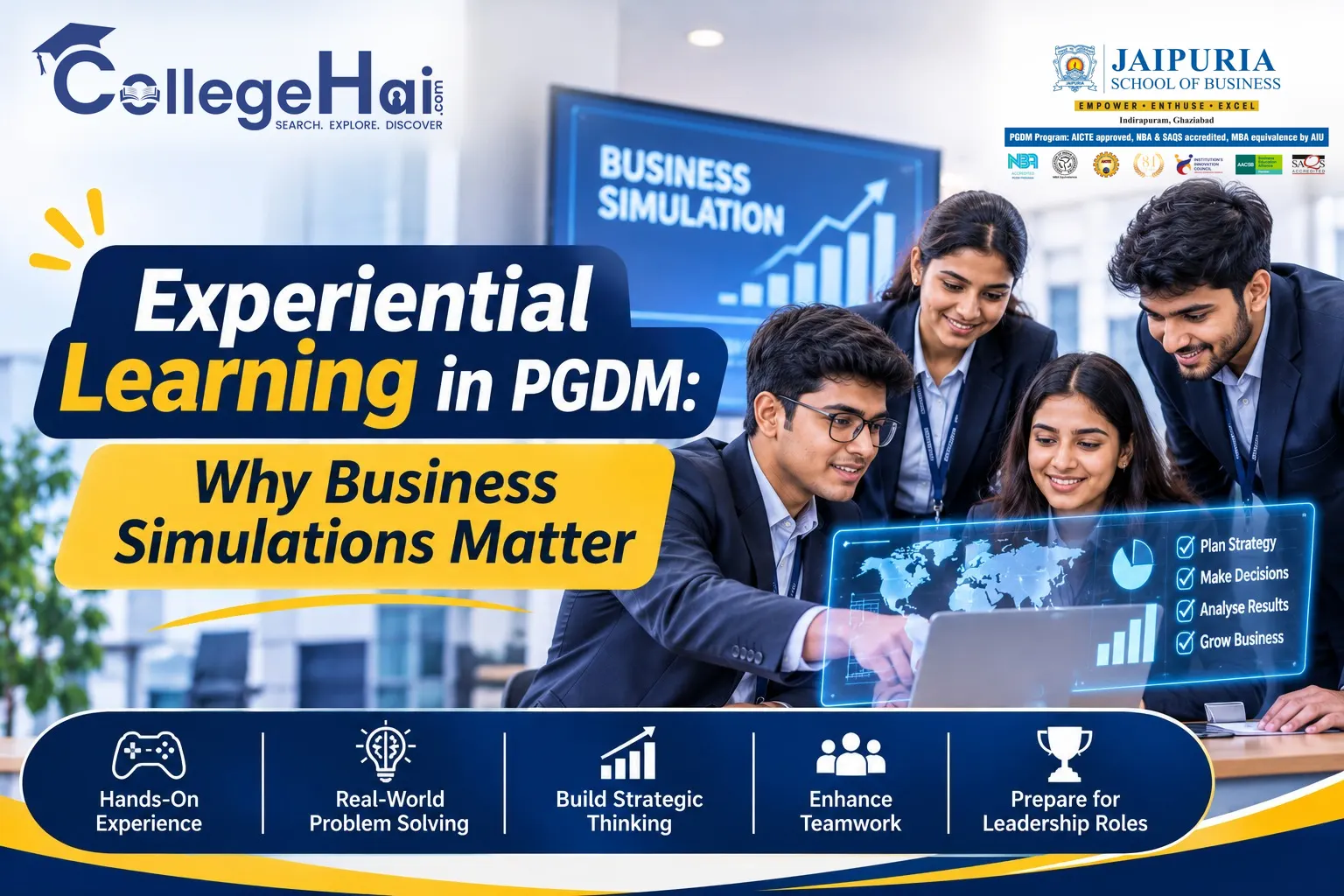
Would you raise a product's price if it improved your margins but might cost you some customers? In a classroom, you can only discuss that question. In a business simulation, you make the call and see what happens. This is the main motive behind experiential learning in PGDM: practising decisions, not just reading about them.
What Is Experiential Learning in a PGDM Programme?
Experiential learning means learning by doing. Instead of only listening to concepts, students apply them to realistic business situations, make decisions and reflect on the results.
This matters because knowing a concept and using it under pressure are two different skills. You may understand pricing theory well, but applying it with limited information, a team to coordinate and results that don't match your expectations is a different challenge.
Why Business Simulations Matter for Management Students
A business simulation puts students in a decision making environment where choices have consequences. Here is what that offers.
- A safe place to make decisions - Mistakes in a simulation cost nothing in the real world. Students can try an approach, see where it fails and try again, which is hard to do on a real business problem.
- Practice comparing options - Most management decisions have no perfect answer. Simulations push students to compare alternatives, weigh trade-offs and choose a direction. This is the habit that separates analysis from judgement.
- Teamwork and coordination - Simulations are usually team activities. Students must agree on a strategy, divide responsibilities and handle disagreements. These are the situations managers face at work every day.
- Responding to surprises - Sometimes the results challenge what you expected. Learning to respond calmly and adjust your plan is a valuable skill for any future manager.
How Jaipuria School of Business, Ghaziabad, Approaches Simulation Based Learning
At Jaipuria School of Business (JSB), Ghaziabad AIMA BizLab supports simulation based learning. It works alongside cases, workshops and assignments so students can link management concepts to real business decisions instead of treating them as separate topics.
JSB also uses Design Thinking and problem based learning. These methods encourage students to investigate a problem and work towards practical solutions. Faculty guidance helps them connect what they experienced with the underlying concepts and build clear explanations for their recommendations.
The Real Learning Happens in Reflection
Playing a simulation is only half the experience. The real value comes afterwards, when students look back and ask:
- Which assumptions were reasonable?
- Where was our analysis incomplete?
- How might a different choice have changed the outcome?
- What did we learn about working as a team?
This kind of review turns a game like activity into a genuine learning experience. It also teaches students to explain their reasoning, which is something employers and interviewers often look for.
Design Thinking and Problem Based Learning
JSB also uses Design Thinking and problem based learning. These approaches encourage students to investigate a problem before jumping to solutions. In practice, that means understanding who is affected, finding the cause and then proposing something practical.
This fits well with simulations. A team that investigates before deciding will usually perform better than one that reacts to every change.
Skills Students Build Through Experiential Learning
Regular practice with simulations, problem based projects and design thinking activities helps develop:
- Communication: explaining a decision to teammates and faculty
- Analytical thinking: reading results and choosing the next move
- Teamwork: dividing roles and handling disagreement
- Judgement: deciding with incomplete information
These capabilities also support placement preparation. At JSB, RISE works on this side of student development, so the skills built in class carry through to career readiness.
What to Ask When Comparing PGDM Colleges
Many colleges mention "practical learning" in their brochures. To understand what it really means, ask specific questions:
- How are experiential activities assessed? Are they graded, reviewed or just optional extras?
- Is there a discussion after each activity? Learning improves when students and faculty analyse the results together.
- Do faculty connect activities with concepts? Hands-on work is more useful when it is tied to management theory.
- How often do students get to practise? Repeated exposure builds confidence better than a single event.
- Is there feedback? Without it, students may repeat the same mistakes.
At JSB, active learning gives students repeated chances to practise judgement, learn from feedback and gain confidence with unfamiliar business problems. That confidence matters later, because real workplaces rarely present problems the way textbooks do.
Conclusion
Experiential learning in PGDM is not about replacing theory. It is about making theory usable. Business simulations let students test decisions, work in teams, face unexpected results and reflect on what they learned. Combined with cases, workshops, Design Thinking and faculty guidance, this approach prepares students for the uncertainty they will meet in their careers.
If you are a PGDM aspirant, look beyond the label "practical learning." Ask how activities are assessed and discussed, and choose a programme that gives you repeated practice in making and explaining decisions. JSB, Ghaziabad, offers this through AIMA BizLab, problem based learning and RISE, which together support both learning and career preparation.
Like what you see? Share this news on :


About the Author
Shikha Rani
Content Writer