BSc Agriculture Programme Guide 2026: Check Eligibility, Duration, Subjects, Fees, Field Training, Admission Process, Career Opportunities and Scope for Higher Studies

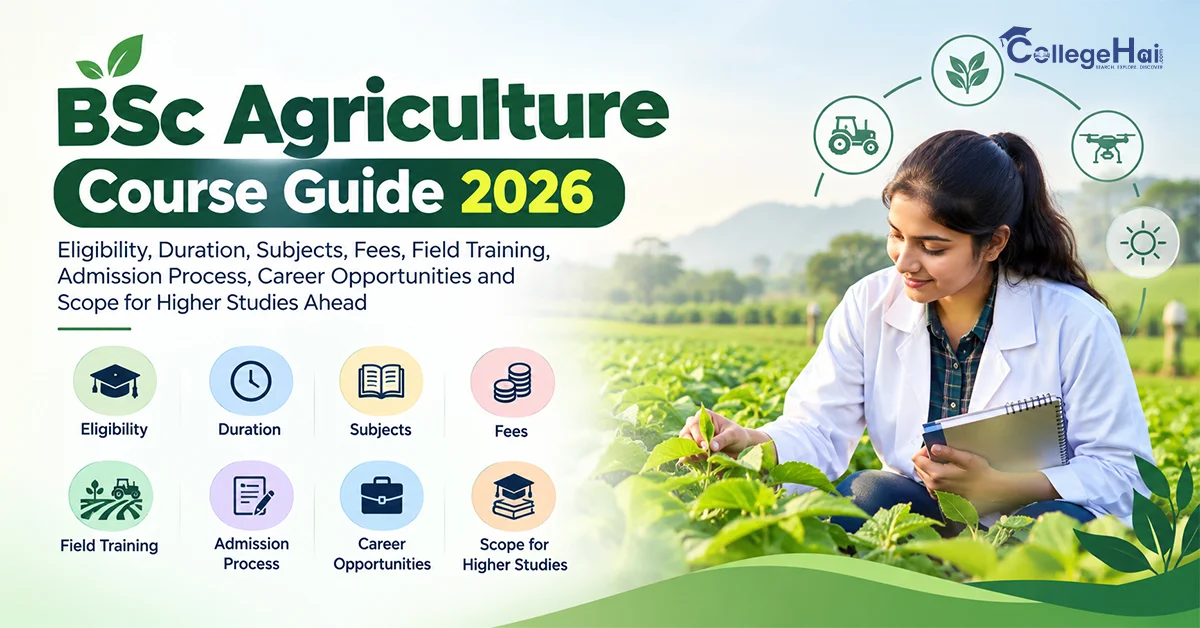
In the modern Era, Agriculture is not limited to traditional farming practices. With the rapid growth in technology, science and research, the agriculture sector has also changed significantly. Today, farmers and agricultural organisations use drones, data analysis, biotechnology, improved seeds, soil testing, irrigation technology and other modern methods to improve agriculture and crop production.
This change has also increased the importance of agriculture–related education. A B.Sc. Agriculture programme helps students to understand agriculture from a scientific point of view. This course covers different areas like crop production, soil science, plant protection, agricultural economics, horticulture and farm management.
However, students must not select a college for B.Sc. Agriculture only by looking at the name of the course and fee structure. Practical experience also matters. Students should check whether the college has the facilities of laboratories, field training, internships, research opportunities and exposure to modern agricultural technologies.
A good BSc Agriculture programme should combine classroom learning with practical activities. Students should get opportunities to work with soil and crops, conduct experiments, understand farming techniques and participate in field-based projects.
Modern Agricultural Science: Moving Beyond Traditional Farming
Traditionally, farming depends on practical knowledge and experience passed from one generation to another. Farmers have always used their knowledge of weather, soil, rain and crops to make better farming decisions. However today farming has become more scientific and technologically driven. Students pursuing a BSc in Agriculture get the understanding of how scientific methods can be used to improve crop quality, productivity and sustainability. They study the biological, chemical and economic factors that affect agriculture. Some important areas for modern agricultural science include:
- Crop improvement and plant genetics
- Soil health and nutrient management
- Pest and disease management
- Agricultural biotechnology
- Climate-smart agriculture
- Farm management
- Agricultural economics
- Precision agriculture
- Agricultural machinery and technology
The use of technology in agricultural practices is also increasingly important. Data can help farmers to understand crop conditions, while modern equipment can support irrigation, soil testing and crop monitoring. Hence, students should look for B.Sc Agriculture programmes which provide a balance between theoretical knowledge and practical learning.
Core Curriculum Framework: What BSc Agriculture Teaches
The B.Sc. Agriculture syllabus generally covers the different areas of agricultural science. The programme begins with basic subjects and then over time students learn specialised topics. In the initial stage, students get to study subjects like biology, chemistry, mathematics and basic agricultural science. These subjects help the students to understand the scientific principles behind agriculture.
In the initial stage, students gain an understanding of different subjects such as biology, chemistry, mathematics and basic agricultural science. These subjects help students understand the scientific principles behind agriculture.
With academic growth, they study more practical-based subjects such as crop production, soil science, plant pathology, entomology, agricultural economics, and farm management. Later parts of the program may include specialized subjects, projects, and field-based activities. The exact curriculum may vary from university to university. Some subjects that an applicant studies are:
- Agronomy
- Soil Science
- Horticulture
- Plant Breeding and Genetics
- Agricultural Economics
- Plant Pathology
- Entomology
- Agricultural Extension
- Agricultural Engineering
- Agricultural Biotechnology
- Farm Management
While comparing colleges, students should also check the practical facilities provided with the programme, which may include soil testing technologies, demonstration farms, crop fields, research facilities and agricultural machinery. The regular practical activities can help students to understand how concepts taught in classrooms are applied in real-life agricultural situations.
Practical Field Training and Lab Components: Developing Agricultural Skills
Agriculture is a field in which practical knowledge is very important. Reading about soil testing or crop production in a textbook is different from actually performing these activities. This is the reason students should check the field training and laboratory components of a B.Sc. Agriculture programme before taking admission.
Practical training can include soil testing and analysis, Crop production experiments, Plant identification, Pest and disease identification. Microbiology laboratory work, Crop demonstration activities, Agricultural machinery training, Farm management projects, Field visits, Internships at agricultural organisations and Interaction with farming communities.
The practical training can provide students with a better understanding of crop growth, soil conditions, farming methods, and agricultural challenges. Along with this, laboratories are equally important. Students may need access to soil testing equipment, microbiology facilities, plant science laboratories and pest identification facilities as part of their practical learning.
Apart from these, internships can also help students to know and understand how agricultural organisations, research institutes and agribusiness companies work. Therefore, students must check whether practical training is included throughout the program and not just for a short period at the end of the program.
BSc Agriculture Eligibility and Admission Requirements
The BSc Agriculture Eligibility Criteria can vary from university to university. Usually, students are required to complete 12th from a well-recognised board with subjects like Physics, Chemistry and Biology, with minimum marks required. The exact marks required for admission can differ from one institution to another, so before taking admission in any college, students must check the latest eligibility criteria.
Besides this, admission to BSc Agriculture programmes can be offered through different methods like merit-based, university-level entrance exam, state-level entrance exam, and other applicable admission processes. Students should also check whether a college requires a specific combination of subjects in class 12th or not for admission.
BSc Agriculture Course Duration
The BSc Agriculture Course Duration offered by different indian institutions is 4 years. The programme usually combines classroom teaching, laboratory work, practical training, field activities and project work. However, the duration of the course and programme structure can vary between institutions. Students should check official programme details before applying.
Career Opportunities After BSc Agriculture
A BSc Agriculture degree can open doors to different career opportunities across government departments, research organisations, agricultural companies, agribusinesses and farming-related businesses. Graduates of BSc Agriculture programme can explore different roles like:
Job Role | Work Area |
Agricultural Officer | Can work in government agriculture programmes and farmer support |
Agronomist | Crop production and farm management |
Agricultural Researcher | Agricultural research and crop improvement |
Farm Manager | Farm planning and operations |
Agricultural Consultant | Advising farmers and organisations |
Quality Control Executive | Quality testing of agricultural products |
Seed Technologist | Seed production and quality management |
Crop Production Specialist | Crop planning and production |
Agricultural Extension Officer | Farmer education and extension services |
Agribusiness Professional | Agricultural products and business operations |
Graduates can also explore entrepreneurship opportunities by starting their farms, food processing businesses, seed businesses, and other agribusiness start-ups. The career growth of the students can depend on several factors like practical skills, work experience, specialisation chosen and higher education. Students who are interested in research, teaching and other specialised technical roles can pursue a postgraduate degree after completing a BSc Agriculture.
BSc Agriculture Fees: What Students Should Consider
The BSc Agriculture Fees can vary depending on the facilities and curriculum offered by an institution. Government colleges offer BSc Agriculture programmes with a lower fee structure, whereas private universities can have higher tuition fees. However, students should not compare colleges on the basis of their total fees. They should also consider facilities and opportunities provided by the institution. Before selecting a university, students can compare:
- Tuition fees
- Laboratory facilities
- Field training
- Research opportunities
- Internship programmes
- Faculty experience
- Agricultural infrastructure
- Farm and demonstration facilities
- Industry collaborations
- Placement assistance
A college with better practical facilities may provide students with more opportunities to develop relevant skills during the programme. Students should also check additional charges, hostel fees, examination fees and other expenses before making a final decision.
Admission Process for BSc Agriculture
Each institution has its own admission process and candidates who are willing to apply for admission in the BSc Agriculture programme must check the eligibility criteria, application dates, and other admission requirements of the institution. A general admission process can include
- Checking the eligibility requirements
- Filling the application forms
- Appearing for the entrance exam if required
- Participating in the merit or selection process
- Completing the document verification
- Paying the admission fee
- Starting the academic programme
Students need to keep their class 10th and 12th certificates, identity proof, photographs and other required documents ready while applying. As the admission rules change with every academic year, students must check the latest eligibility criteria before admission.
Higher Education Opportunities After BSc Agriculture
A BSc Agriculture degree can not be the end of the candidate’s academic journey; it can be the starting point for deeper specialisation. Applicants looking to build advanced expertise in different fields can pursue postgraduate programmes across agriculture and allied sciences, which can lead to ample career, research and high-level opportunities. The popular options after completing a Bachelor’s include:
- MSc Agronomy
- MSc Horticulture
- MSc Soil Science
- MSc Plant Breeding and Genetics
- MSc Agricultural Economics
- MSc Plant Pathology
- MSc Entomology
- MSc Agricultural Biotechnology
- MSc Agricultural Extension
- Master's programmes in Agricultural Engineering
Higher education can help students to develop specialised knowledge and skills required for research, teaching, technical and managerial roles. Students who are interested in research and academics can also pursue a PhD after completing their master’s.
Agriculture is continuously developing because of climate change, biotechnology, precision farming, artificial intelligence and other technologies. As a result, professionals may need to keep developing their knowledge through certifications, specialised courses and additional training.
Why Consider Amity University Noida for BSc Agriculture?
Before selecting a college for a BSc Agriculture programme, students should check several factors before admission. These include practical learning, laboratory facilities, field exposure, faculty expertise, internships, research opportunities and industry networking.
The BSc Agriculture programme offered by Amity University Noida combines agricultural science with practical learning. Students gets practical exposure to different fields of agriculture through classroom teaching, laboratory activities and projects.
This programme of Amity University covers important topics of agriculture education and helps students to develop knowledge of crop production, soil science, horticulture and related agricultural subjects. Students choosing Amity University Noida should check the latest information about the programme such as BSc Agriculture fees, eligibility, admission process, syllabus, practical facilities, internships and placement support.
The availability of practical facilities is also important for agriculture students as field-based learning can help them to understand agricultural concepts easily and effectively. Before taking admission, students should compare the programme with other BSc Agriculture colleges based on curriculum, facilities, practical exposure, faculty, fees and future opportunities.
Scope of BSc Agriculture in India
The agriculture sector provides students with different opportunities across farming, research, food production, agricultural technology, agribusiness and government services. With time, agriculture is becoming more technology-driven. Graduates with knowledge of both agriculture and modern technologies can explore different career paths. Students can work in areas such as:
- Crop production
- Agricultural research
- Seed and fertiliser companies
- Food processing
- Agribusiness
- Agricultural consulting
- Government agriculture departments
- Rural development
- Farm management
- Agricultural technology
The scope of BSc Agriculture can also expand when students combine their undergraduate education with internships, practical training, specialised certifications or postgraduate education.
Like what you see? Share this news on :


Frequently Asked Questions
A B.Sc. Agriculture is an undergraduate programme that covers different topics like crop production, soil science, plant protection, agricultural economics and farm management. After pursuing this programme, students get the opportunity to work in roles such as agricultural officer, agronomist, researcher, farm manager, consultant, and agribusiness professional.
The main subjects covered under the B.Sc. Agriculture programme include agricultural science, biology, chemistry, soil science, crop production, plant protection, agricultural economics and farm management. The subjects can vary depending on the university and students can also study horticulture, genetics, biotechnology and agricultural technology.
For admission in the B.Sc. Agriculture programme, candidates are required to complete their class 12th with subjects like Physics, Chemistry and Biology. The minimum marks required for admission can vary from university to university and some institutions can also conduct an entrance exam for providing admissions.
The BSc Agriculture course duration is 4 years in most of the indian universities. The programme usually includes classroom learning, laboratory work, field training, practical activities and projects. Students should check the exact duration of their chosen university.
The BSc Agriculture Fee can vary depending on the college, university and facilities provided. Government colleges generally have lower fees, whereas private universities have a higher fee structure. Before admission, students would compare practical facilities, field training, internships and other academic opportunities.
After BSc in Agriculture, students can work in government departments, research institutes, agricultural companies, agribusinesses and farming organisations. They can also pursue master's programmes in areas such as agronomy, horticulture, soil science, genetics and agricultural economics.
Yes. After BSc Agriculture, students can pursue postgraduate programmes in specialisations such as agronomy, horticulture, soil science, plant breeding, agricultural economics, biotechnology and other related fields. Students interested in research can later pursue a PhD.
About the Author
Tanisha Malhotra
Content Writer