JEE Main 2026 Admit Card: Important Details You Must Check Before Exam Day

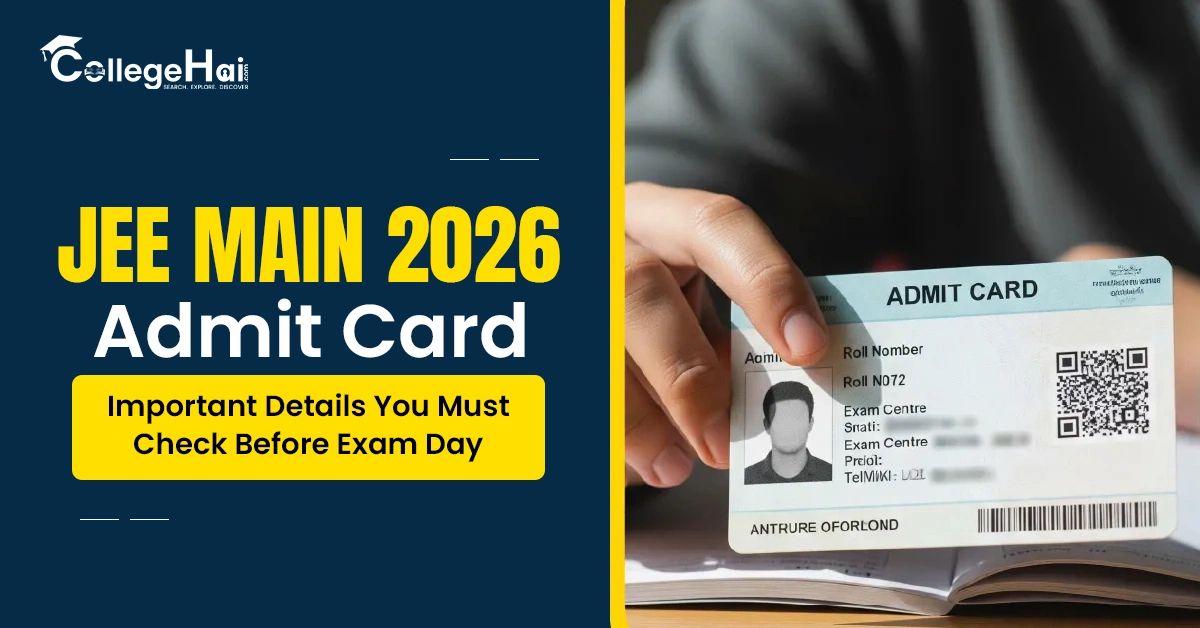
Future engineers, mark your calendars as the JEE Main 2026 Session 1 admit card (hall ticket) will be released in the third week of January 2026, around 3-5 days before your exam date, as per NTA's standard schedule. Once they are out, visit jeemain.nta.ac.in, log in with your application number and date of birth and download the PDF instantly. Moreover, remember that no tangible copies are dispatched, hence it is your responsibility to have them printed out on A4 paper for the examination room.
In other words, the JEE admit card is a paper of no compromise as entry is possible without it. It carries your individualized exam date (probably late January for Session 1), the time to report (typically 7:30-8:30 AM), the shift (morning/afternoon), roll number, the location of the test centre with a map, and your photo/signature along with a comprehensive list of rules such as restricted items (calculators, watches) and dress code. Thus, it is essential to monitor the details for the JEE Main 2026 admit card. In this blog, you will get a checklist that you can't ignore.
Details to Check on JEE Main 2026 Admit Card
JEE Main is the most important exam for Indian engineering students. More than just a hall pass, the JEE Main admit card contains important exam details, such as personal data, and some of the basic rules that every student needs to follow. To ignore the last-minute anxiety, students should carefully check the information which is given on the admit card. The following are some crucial details that students should carefully review:
1. Personal Detail:
The key part of your admit card is your personal details. A minor error can result in significant problems on the day of the exam. Common information included in personal details consists of:
1.1) Name: You have to ensure that your complete name is spelt accurately. It must correspond with your official school or board documentation. A name mistake might lead to problems at the exam centre regarding verification.
1.2) Date of Birth: Students must confirm that their birthdate matches their birth certificate or academic records. Mistakes can lead to misunderstandings in the application and outcome processing.
1.3) Parents' Name: Verify the names of your mother and father to confirm their accuracy. Occasionally, a small spelling error happens, requiring prompt correction.
1.4) Classification: You also need to make sure that your classification is accurately stated (General, OBC, SC, ST, etc.). Errors in the category can impact the advantages of reservations.
2. Exam Details:
The​â€â€‹â€Œâ€â€‹â€â€Œâ€‹â€â€‹â€Œâ€â€‹â€â€Œ admit card has various essential pieces of information regarding the examination, which are explained further below:
2.1) Exam date is a very important event for the JEE journey. The first thing students must check on the admit card is the exam date.
2.2) JEE Main runs in multiple shifts, so students' admit cards will clearly mention whether they’re a morning warrior or an afternoon achiever. Knowing shift helps students to plan their sleep schedule, travel time, and exam-day routine perfectly.
2.3) Reporting time isn’t up for debate. Your admit card spells out exactly when you need to be at the exam centre. Generally, you should arrive at least two hours before the test begins. If you show up late and you cannot get in, no matter what. Get there on time, and you can relax and start the exam without any extra pressure.
2.4) The JEE Main gives you three hours to finish the paper. Knowing this ahead of time helps you set up a game plan, decide which section to start with, figure out how long to spend on each question, and keep yourself moving without freaking out.
3. Exam Centre Details:
You’ll find all the details about your exam centre right on your admit card. Here’s what you need to pay attention to:
First, check the name of the school, college, or institute where you’ll take your exam. Don’t just skim this—double-check so you don’t land at the wrong place.
Next up, look at the full address. Make sure it lists everything: city, state, and pin code. You don’t want to waste time searching for the location on exam day.
Finally, there’s the centre code. NTA uses this code to keep things organised, and it should match the one you got when you registered. Take a second to confirm it’s the same.
4. Roll Number and Application Number:
Your admit card contains some special numbers that are very important for identification and checking results:
1. Application Number:
This number is created when you register for JEE Main.
Think of it as your personal ID for the exam.
You’ll need it to download your admit card, answer key, and results.
2. Roll Number:
A unique number assigned specifically for your exam.
It helps in tracking your exam performance and checking your results later.
5. Exam Day Instruction:
Your admit card contains key instructions you must follow to avoid any issues on exam day. Here are the main points:
1. Things You Can Bring:
Admit card
Valid photo ID (like Aadhaar, Passport, or PAN)
Basic stationery (pens, pencils, erasers)
2. Things You Cannot Bring:
Watches, calculators, or electronic gadgets
Mobile phones
Notes, papers, or any written material
3. Seating Instructions:
Always follow the exam centre’s directions for where to sit.
Don’t change your seat without permission.
6. Photograph and Signature:
The admit card contains a photograph and signature, which must be verified carefully for further references:
6.1) Photograph: The photo on the admit card should be recent and clearly visible. It is used for identity verification at the exam centre.
6.2) Signature: Students should make sure that the signature is clear and matches the original signature submitted during registration.
7. Exam Mode and Language:
The admit card also mentions the exam mode and the language students select for the question paper. Checking these details ensures that you are fully prepared for the test format.
1. Mode of Exam:
JEE Main is a computer-based test (CBT).
Make sure you are comfortable using a computer to take the exam.
2. Exam Language and Support:
Help desk information or emergency phone numbers may be included on admit cards.
Have these on hand in case you run into any problems at the exam location or while travelling there.
How to Correct Discrepancies in JEE Main 2026 Admit Card
Sometimes,​â€â€‹â€Œâ€â€‹â€â€Œâ€‹â€â€‹â€Œâ€â€‹â€â€Œ students find that their JEE Main admission cards have some kind of error, for instance, a wrong spelling of words, a photo placed wrongly, or incorrect information regarding the exam. Fixing these errors is the first thing you should do to be able to go with confidence on the day of the exam. Here is a step-by-step guide to making correction ​â€â€‹â€Œâ€â€‹â€â€Œâ€‹â€â€‹â€Œâ€â€‹â€â€Œrequests.
Step 1- Contact NTA Helpline
The official NTA Helpdesk number, which can be found on the official website, should be called by students.
Clearly state the errors that students have discovered in the name, photo, signature, category, and other areas.
Step 2- Send an Email to NTA
If calling them doesn’t work, then students need to email them. With their name, application number, mobile number, and what the problem is, attach a document that proves the correct information.
Step 3- Check the website regularly
NTA sometimes opens a correction window. Visit the official website daily to see if any update is posted.
Step 4- Do not wait till the Last day
As soon as your admit card is made available, check it. NTA might not have enough time to correct the error if you wait.
Step 5- Carry ID Proof on Exam Day
If your issue is not fixed in time, carry a valid ID (Aadhaar, PAN, passport, etc). Carry the email reply or complaint number as proof. This helps in case the exam centre has questions.
Conclusion
The JEE Main 2026 admit card is basically your ticket to the exam. It’s got everything you need: your exam centre, your personal info, timings and a list of instructions for the big day. Don’t just glance at it. Go through every detail. If something’s off, reach out to the NTA helpdesk right away and get it sorted. Prepare all of your paperwork in advance and download and print your admit card in advance. You'll avoid a great deal of stress at the last minute if you do this. That way, you can actually focus on what matters most: giving it your all in the exam.
Like what you see? Share this news on :


