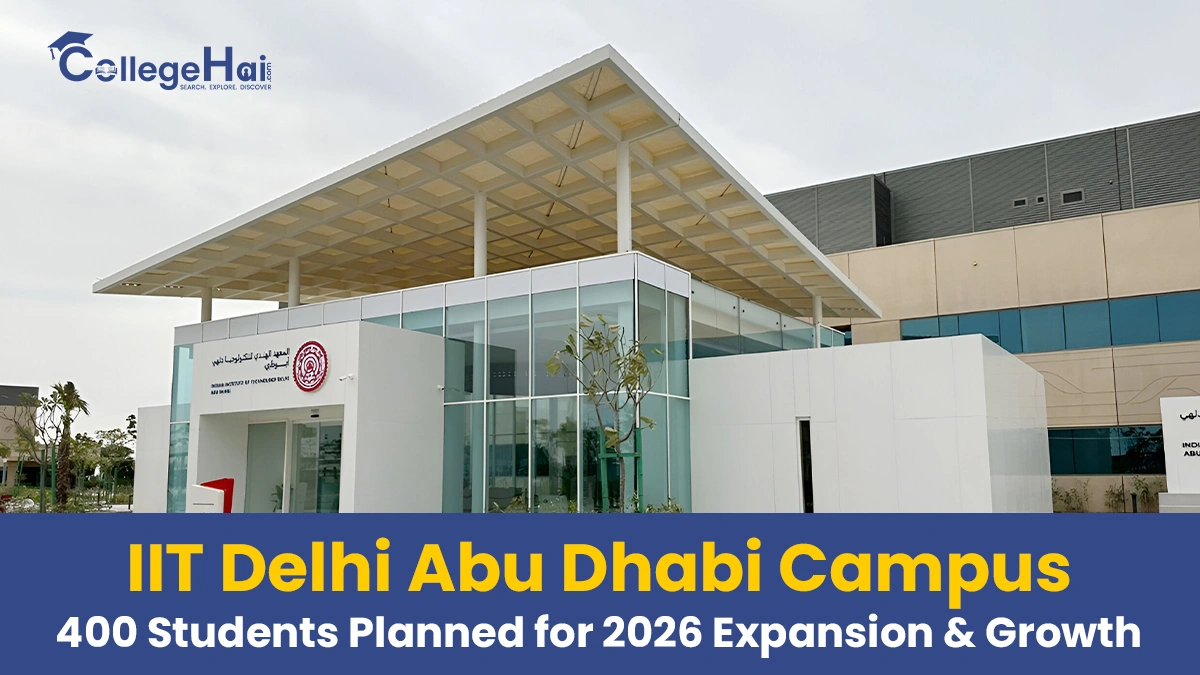
The Indian Institute of Technology (IIT) Delhi Abu Dhabi campus is going to expand massively in the number of students. The number of students is expected to reach around 400 in the next academic year, which is almost double the current number. This was confirmed by Shantanu Roy, Executive Director of IIT Delhi-Abu Dhabi, during an interaction with Indian media representatives who were visiting. In fact, the total student strength of IIT Delhi is almost 12,000, while the Abu Dhabi campus has only 182 students. Roy stated that the sharp rise is a reflection of the university's plan for gradual expansion in the UAE.
IIT Delhi-Abu Dhabi Campus Sharpened by Regional Priorities
Comparing the Abu Dhabi campus to the IIT campus in India, Roy affirmed that the main difference is to be found in location and regional considerations. While India's huge population and economy set the academic priorities, the UAE is a different story.
Once dependent on fossil fuels, the UAE is now diversifying its economy at a fast pace. The education and innovation ecosystem that is being done around the Abu Dhabi campus is very much in line with this change.
Even with its location in a small country, the Abu Dhabi campus of IIT Delhi manages to attract a very diverse student body from different parts of the world. Roy explained this by the UAE's global crossroads position, which connects Europe and Asia, and hence, the diverse enrolment is a logical outcome of that.
IIT Delhi Abu Dhabi Academic Focus: Energy, Sustainability, AI, Smart Materials
The Abu Dhabi campus has a strong focus on such areas as energy, sustainability, artificial intelligence (AI), and smart materials. Roy explained that these are also the main topics at IIT Delhi in India and that both campuses are academically coordinated. “We are one institution, not separate entities,†Roy stated to emphasize that IIT Delhi is one global institution with three campuses and that Abu Dhabi is its first international campus.
IIT Delhi Abu Dhabi Campus Growth
The campus started with a modest 17 students and a master's programme in the first semester. Then, within six months, it started two bachelor programmes and had the student enrolment of around 50. The plans at IIT Delhi-Abu Dhabi are as follows:
Introduce an additional undergraduate programme each year
Introduce new master's programmes each year
Expand PhD programmes progressively
Curriculum Aligned with IIT Delhi
Artificial Intelligence forms the core of IIT Delhi's academic framework, which also includes specialized master's degrees in AI. Roy shared that the Abu Dhabi campus mostly follows the same curriculum as IIT Delhi, with a few changes to suit the Middle East region.
Accreditation standards for international branch campuses emphasize that the academic spirit of the parent institution should be retained. Therefore, students get similar education in Delhi and Abu Dhabi with only slight differences based on the local context.
The campus is engaged in a partnership with Mohamed bin Zayed University of Artificial Intelligence (MBZUAI) as well. This collaboration facilitates advanced AI education for local and international students. IIT Delhi-Abu Dhabi will be launching a master's programme in AI, which is already available at the Delhi campus.
IIT Delhi Abu Dhabi Permanent Campus Update
The Abu Dhabi campus, the local branch of IIT Delhi, is presently located in Khalifa City, a transit facility. Roy pointed out that despite the fact that the hardware is decent, the permanent campus is still a few years away. The permanent campus, as per the plan, will be able to meet international standards, especially in terms of sustainability and eco-friendly design, once it is developed.
Admissions and Entry Routes: JEE Advanced and CAET
The IIT Delhi Abu Dhabi campus was launched officially on September 2, 2024, after a bilateral agreement between India and the UAE. Undergraduate admissions are held through:
JEE Advanced (about one-third of the seats)
Combined Admission Entrance Test (CAET) is a local admission test for the residents of the UAE and is open to expatriates who have lived in the country for at least five years.