How to Build an Academic CV for Studying Abroad

An academic Curriculum Vitae is basically an elaborated record of your education, research, skills, and academic accomplishments, particularly for study abroad applications. It is quite different from a job resume that highlights your professional work experience and skills that are most relevant to a job. The academic CV is more of a showcase of your educational achievements, your research capacity, and your academic level to be able to handle a challenging program in ​â€â€‹â€Œâ€â€‹â€â€Œabroad.
Creating a powerful academic CV is about presenting your information in a logical way through your educational background, research, skills and participation in activities. You should make sure that your contact info, a short profile summary or statement of purpose, education background, academic projects or papers, international experiences, and references if any are the core sections of your CV. Every section has to be a step ahead in showing your academic readiness and fitting the program you have chosen, thus giving a full and convincing view of your potential as a global ​student.
Understand What Admissions Committees Look For
A study​ingâ€â€‹â€Œâ€â€‹â€â€Œ abroad CV should have a well-rounded profile, which is accepted by the admissions committees. International universities while selecting candidates for their competitive and in-demand programs readily look for certain qualities, which include the student's performance at school, awards, scholarships, research, skills, leadership, conferences, and global adaptability, all of which demonstrate the student's readiness for competitive programs. The five areas that these committees specifically focus on are as follows:
Academic Strength: The factor of academic strength and intellectual compatibility plays an important role in​â€â€‹â€Œâ€â€‹â€â€Œ competitive academic shortlisting. The performance at your school, well-known awards, challenging coursework, and scholarships are the factors that show your capacity to be successful in the programs. Besides, the selection committees take into account the research projects, publications, skills of a technical and analytical nature, academic leadership, participation in conferences and competitions, as well as the global adaptability through experiences abroad and involvement in the community. Thus, raising the chance of getting in at the leading ​â€â€‹â€Œâ€â€‹â€â€Œuniversities.
Research Potential: The university committees keenly look for students going into Master's or PhD programs who have research experience. Consequently, they look for research projects you’ve completed, any published works or accepted papers you hold. All of this information indicates a student's ability to add to the body of knowledge in their field.
Skills and Competencies Relevant to the Program: These include both your technical skills, such as coding, lab techniques, or computer software proficiency, and your soft skills, such as communication, leadership, and teamwork, all of which highlight that you have the capability to be both academically successful, and, also, an active participant in the social aspect of attending a university.
Well-Roundness: The admissions committee appreciates a well-rounded student who has demonstrated an interest in various extracurricular activities and who has engaged in community-service initiatives and volunteerism. This indicates to the admissions committee that the student demonstrates initiative, responsibility, and a broad range of interests outside of the academic setting.
Cultural Fluidity: Your ability to succeed academically on a global scale, and your willingness to contribute to a multicultural campus environment, is evidenced by your familiarity with foreign languages and your background in international travel, either having studied or lived in a foreign country, as well as demonstrating your ability to culturally adapt.
Knowing these points will allow you to create a CV that binds you closely to university requirements and thus will let you stand out among other ​â€â€‹â€Œâ€â€‹â€â€Œapplicants
How to Tailor Your Academic CV to the Program or University
Mirror Program Keywords: Scan the course description and university page for specific terms (like, "machine learning," "sustainable development") and integrate them naturally into projects, skills, and research descriptions to pass Applicant Tracking Systems filters and signal fit.​
Align with Faculty Research: Research the faculty of your applied department and match your interests to their ongoing projects. You can also cite a professor's paper in your research section by demonstrating genuine synergy for grad programs.​
Prioritise Region-Specific Elements: Modify​â€â€‹â€Œâ€â€‹â€â€Œ length, content, and GPA (converted to the university's scale) to correspond with the standards of the target program, emphasising languages if ​â€â€‹â€Œâ€â€‹â€â€Œneeded.
Link to SOP and Program Goals: Cross-reference your profile summary or SOP with unique university features (e.g., labs, centres), clarifying how your background advances their mission.​
Highlight Global Adaptability: Amplify cross-cultural experiences, proficiency skills, and international exposure using quantifiable impacts (for example, "Led multicultural team, 20% efficiency gain") to show study-abroad readiness.
Writing Style, Format & Presentation Tips
Here are some insights as to the writing style, formatting and presentation tips that you might like to keep in mind while building your CV:
Regional Variations: The​â€â€‹â€Œâ€â€‹â€â€Œ CV requirements for study abroad applications differ from one region to another. CVs in the US are kept brief and limited to 1 page with the focus being on the achievements and only the degree and GPA details. UK versions are 2 pages long for detailed history and listing of subjects, grades, and modules, with very few personal details. In Europe, the preferred length is 2-3 pages for master's and PhD programs, with the main emphasis on research and publications, complete coursework projects, and the most fluent languages.
Suitable Format: Make your CV brief and appropriate. Do not use empty words or give details that do not reflect your character. Present your CV in a simple, minimalistic style with a normal font, understandable headings and bullet points. Do not use colours or a fancy way of writing that is not necessary.
​â€â€‹â€Œâ€ATS-Friendly Design: In order to make your resume friendly to Applicant Tracking Systems, you should use clear and standard headings like "Education" and fonts that are simple such as Arial or Calibri with a font size of 10-12 pt. Do not scatter the content throughout the page but rather keep everything in one column and don’t forget to put the keywords from the program description. You should refrain from using tables, pictures, or decorative headers is as most ATS systems cannot interpret these elements.
Action Verbs & Metrics: Select strong verbs like "Developed", "Led" or "Implemented" to introduce your bullet points. In case you have the opportunity, support them by quantifiable results - for instance, "Optimized an algorithm, increasing speed by 15%."
Final Polish: Give your resume the final go by proofreading it several times, inserting the link to your LinkedIn profile, and finally, saving your work as a PDF to ensure that the formatting will be ​â€â€‹â€Œâ€â€‹â€â€Œunchanged.
Recommended CV Structure & Sections
Here is a section-wise breakdown for a CV tailored to focus on studying abroad. Go through the format thoroughly in order to structure your curriculum vitae accordingly. You will be able to greatly benefit from this structure, as it clarifies everything you need to know.
1. Contact​â€â€‹â€Œâ€â€‹â€â€Œ Information: Top of your CV should have your name, email, phone, and address. Don't overdo it and keep it professional and straightforward. Certainly, if you have a LinkedIn - put it up. It's a quick way for the admission committees to reach out to you.
2. Statement of Purpose (Optional): Just write 1 or 2 brief sentences that tell what you'd like to study and why you'd pick this program. It really conveys your entire CV's theme. Connect it with your objectives and abilities.
3. Education: First of all, write down your degrees in reverse chronological order. Mention the school with years, GPA or grades, main subjects, awards, and scholarships. This is a strong point of your academic background.
4. Research Interests (especially for grad applicants): Firstly, highlight 2-3 topics that you are interested in. Then, align them with the department of the university. It is the evidence that you are a good fit for the university's research areas.
5. Work Experience (if relevant): Firstly, list your jobs or internships that have been in your area of interest. Apply the CAR model: Challenge, Action, and Result and describe your role in this format. Indicate a substantial effect with figures if you can.
6. Academic Projects and Publications: Choose work that you have done. Talk about your role, the tools you used, and the outcomes. Introduce any paper or presentation that you have presented priorly. The main idea here is to demonstrate your practical work.
7. Skills & Competencies: Firstly, Tech skills such as programming or experimental work should be included in your skill set. Secondly, soft skills like leadership or cooperation can be stated as well. However, a few examples should be presented to support these claims.
8. Certifications & Courses: Identify helpful certifications such as language tests or remote learning that you have done. Mention the provider and date. Only add trusted ones.
9. Extracurricular Activities & Achievements: Write down clubs, sports, volunteer works, or leadership positions that you have been a part of. Describe how they developed your skills and interests. This will provide you as a complete person.
10. Global Exposure (if any): Highlight far away school trips, exchange, travel, or skills in speaking foreign languages. Elaborate on the cross-cultural experience. It's a sign that you're geared up for life internationally.
11. References (if required): Write down the professors or mentors along with their name, job title, school, and contact information. Be sure to get their permission first. If you are not at the stage where you need to refer, it's better to say 'available on ​â€â€‹â€Œâ€â€‹â€â€Œrequest'
Common Mistakes to Avoid in a Study Abroad CV
Adding Photos or Personal Details: Students often attach pictures of themselves and also add details like their age, marital status, religion, or even the names of their parents. However, the international admission committees view this as being biased or unprofessional. Just keep it simple with your name and contact details, no personal identifiers are necessary for academics.
Too Long or Fancy Formatting: An undergraduate CV should be no longer than one page, whereas a graduate CV can be up to 2-3 pages. The use of colours, images, tables, or creative fonts should be avoided as they interfere with ATS parsing and also give a messy look to the readers. It is better to use simple black text on a white background.
Spelling/Grammar Errors: Only one typo can significantly highlight the lack of attention to detail. Make sure you proofread your work three times, use grammar tools and also get a mentor to check your work. Committees reject sloppy work straight away.
Generic or Irrelevant Info: The listing of random hobbies, old jobs, or duties such as "did project" is a waste of space in your CV. Concentrate only on those experiences that are related to the program and get rid of everything that is off-topic.
Lack of Keywords or Metrics: Without the use of program-specific terms (for example, "data analytics"), ATS will not allow your application to go forward.
Not Tailoring Per Application: The act of resending the same CV to different places without making changes for each university is like disregarding the differences between universities. Each program should have its own keywords, order, and focus that help you demonstrate that you are the right ​â€â€‹â€Œâ€â€‹â€â€Œfit.
Sample Template Layout
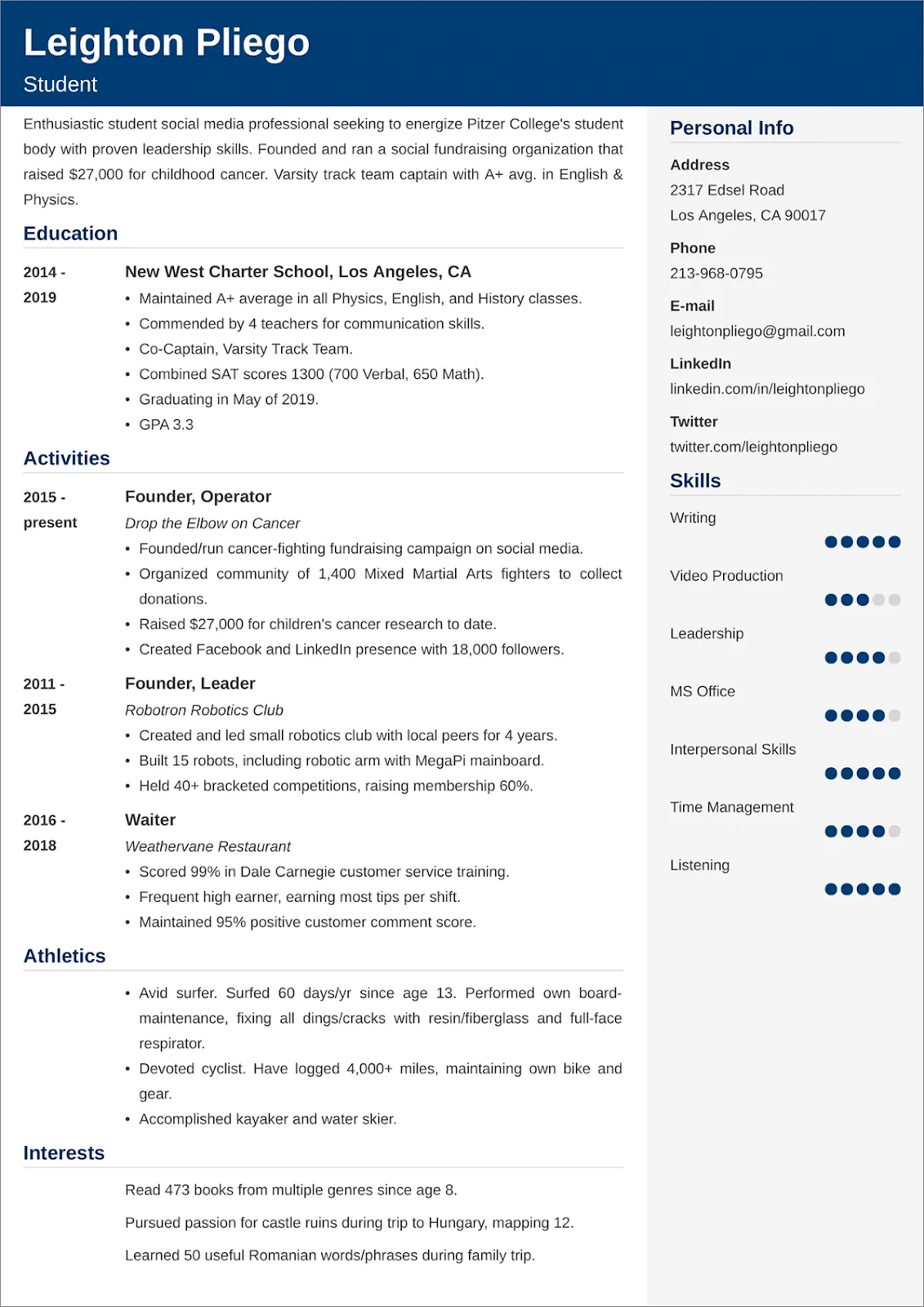
To make things easier for you further, here is a sample of CV that you can refer for making your personal CV for studying abroad:
Conclusion
An​â€â€‹â€Œâ€â€‹â€â€Œ efficiently planned, truthful CV which is adjusted to your academic strengths is the main factor of a successful study abroad application, as it allows the committees to see clearly and genuinely your academic progress and personal qualities. In comparison with work resumes, an academic curriculum vitae will highlight more of your abilities for courses, research, leadership, and international life, thus giving evidence that you are capable of handling challenging and diverse university environments. Make your CV different for every program to be noticed, and also invest time in it to be sure that it is of great quality, as it always wins over quantity. Concentrate solely on the experiences that demonstrate that you are the right ​â€â€‹â€Œâ€â€‹â€â€Œone. These small steps will take you one step closer to your dream university.
Like what you see? Share this news on :


