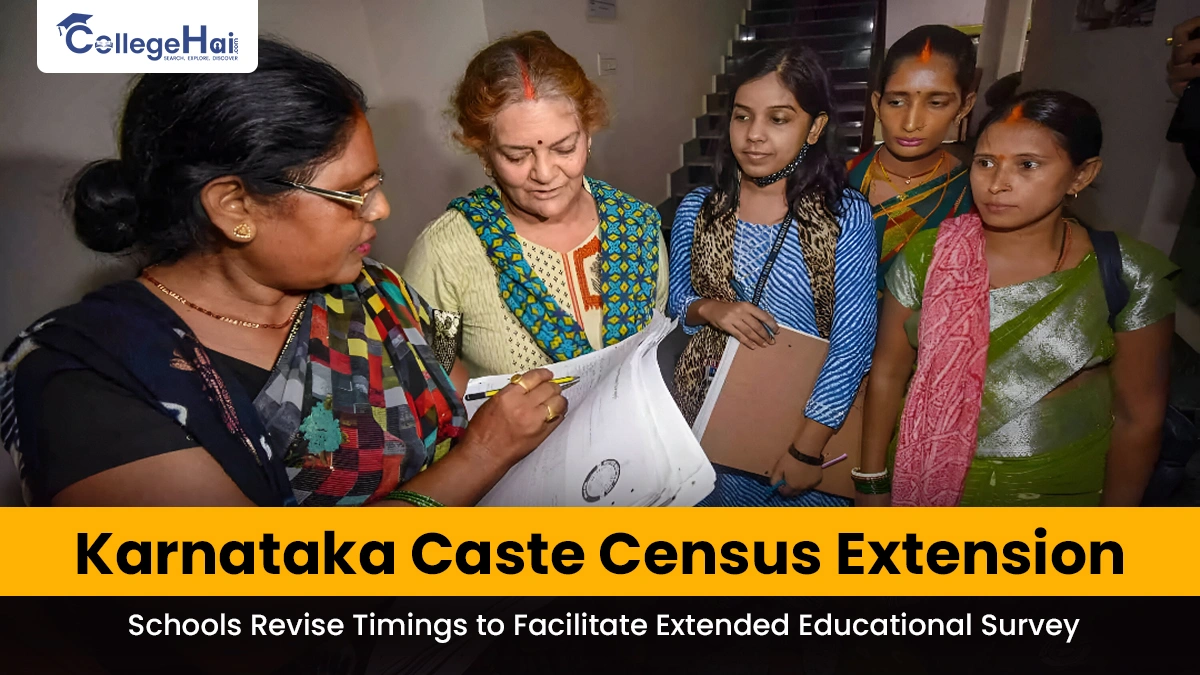
The Social and Educational Survey (SES), better known as the 'caste census,' was expected to be completed on Tuesday, but it seems the survey will be extended. As per a departmental order from the Department of School Education and Literacy, it has been decided to change the school hours, enabling the teachers to administer the survey after the Dasara break. In Greater Bengaluru, government and aided schools will have classes from 8 am to 1 pm from October 8 to 24. During this period, the teachers engaged in the survey will accompany the respondents in the field and complete the survey after school hours.
In the rest of Karnataka, schools will run from 8 am to 1 pm from October 8 to 12. The note, dated October 6, refers to a communication by the Backward Classes Welfare Department stating that the survey could not be completed within the time frame, and hence a deadline extension is required. The alteration of school timings has been made to provide a continuous study to the students and to ensure that classes are not affected by the survey after the mid-year holidays.
Survey Delayed for Training and Necessary Preparations
The Karnataka State Commission for Backward Classes is now conducting the Social and Educational Survey. On September 22, it began and was originally planned to finish on October 7. In the Greater Bengaluru area, the survey got a late start as the authorities required more time for the training and preparation. It is still ongoing.
According to officials, the survey is being done methodically and scientifically with the help of a 60-question questionnaire. The Commission is expected to make a formal announcement regarding the extension of the survey very soon. This survey has been estimated by the government to cost INR 420 crore. A similar survey by the state of Karnataka was done in 2015, and the expenditure was INR 165.51 crore. However, the results of that survey were rejected.
Presently, the survey's focus is on capturing the social and educational status of communities in the state with as much detail and accuracy as possible. Officials are optimistic that this data will be instrumental in the efficient planning of welfare schemes and policies for backward classes and other communities.